

Key takeaways about touching yourself as mortal sin
In Catholic teaching, masturbation is considered grave matter because it separates sexuality from its purpose of marital love and openness to life.
Masturbation is only a mortal sin if three conditions are met: grave matter, full knowledge, and deliberate consent.
A sin becomes mortal when it is serious, done knowingly, and chosen freely without significant impairment.
Factors like addiction, habit, or psychological struggle can reduce personal responsibility, even if the act remains objectively serious.
The Catholic Church teaches that sexual activity is meant for unity between spouses and openness to life, which masturbation does not fulfill.
Involuntary thoughts, biological arousal, and actions without full awareness are not considered sinful because they lack deliberate consent.
Catholic teaching distinguishes guilt from shame, emphasizing repentance, confession, and God’s mercy rather than condemnation.
Overcoming habitual sin involves repentance, spiritual discipline, and often external support to address underlying struggles.
Frequently asked questions about touching yourself being a mortal sin
Is masturbation a mortal sin in Catholicism?
Masturbation is considered grave matter, but it is only a mortal sin if it is done with full knowledge and deliberate consent.
What makes a sin mortal?
A sin is mortal when it involves grave matter, full knowledge that it is wrong, and deliberate consent to commit the act.
Can addiction reduce the severity of the sin?
Yes. The Church teaches that addiction, habit, or psychological factors can reduce personal responsibility, even if the act itself remains serious.
Why does the Catholic Church consider masturbation wrong?
Because it separates sexual activity from its intended purposes: unity between spouses and openness to life.
Are involuntary sexual thoughts or actions sinful?
No. The Church teaches that sin requires conscious and deliberate consent, so involuntary thoughts or reactions are not considered sinful.
Relay is a therapist-backed group recovery program for pornography and unwanted sexual behavior, combining daily accountability, real-time urge support, and a private peer community.
Is Touching Yourself a Mortal Sin? Does God Forgive This Struggle?
For a deeper explanation of the theology around this question, see our full guide to whether masturbation is a sin.
Every good Catholic wants to know if it is a sin to touch yourself. And-if it turns out that masturbation is a sin-what type of sin it is. The question isn't as simple as "Is it against the law of God and Scripture to masturbate?" If it turns out that touching yourself is a sin, then we have to ask ourselves, "Is masturbation a mortal sin or a venial sin?"
Let's look at what the Bible and the Catechism tell us about masturbation's place among the sins and what we can do about it if we want to save our souls.
But first, we have to define "sin." Defining such a basic idea as sin might seem trivial, but it's the key to making sense of God and the Church's stance on pleasuring yourself.
Further reading: 32 Bible Verses on Masturbation and Lust-What Scripture Really Teaches About Desire And Self Control
Bible translations used:
Scripture quotations in this article are primarily taken from the King James Version (KJV) for consistency. In select cases, the New International Version (NIV) is referenced for clarity or comparison of wording. In addition to Scripture, this article references the Catechism of the Catholic Church where relevant to clarify how historic Christian teaching has interpreted sexual morality, conscience, and self-control.
How Does the Bible Define Sin?
This exact definition of sin varies among Christian denominations, but the following is precise enough to be universally accepted as the correct understanding of sin. All Christians—Protestants, Methodists, Catholics, Orthodox, etc.—will agree with the following:
Sin is freely choosing anything—whether in thought, word, or action—that goes against God’s will and harms your relationship with Him, others, or yourself.
Sin isn’t an accident. It’s a deliberate choice that goes against God’s will and design.
A sin can also be an act of commission (telling a lie or robbing someone) or an act of omission (not telling the whole truth or not correcting the cashier when they give you too much change back).
Another way to look at this is that sin has four dimensions, and the Bible clearly teaches each one.
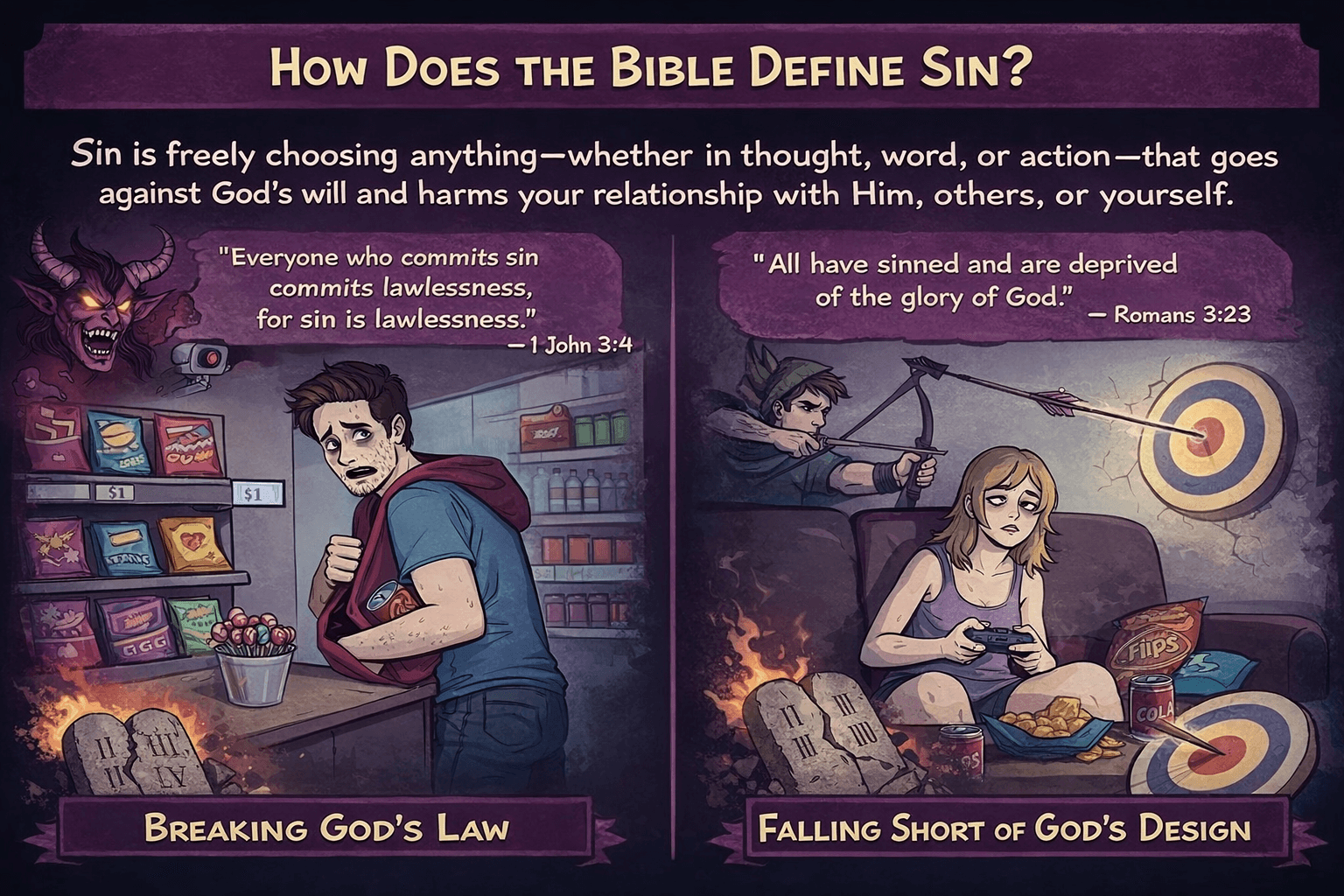
Breaking God's Law
When Scripture speaks of “God’s law,” it isn’t just referring to the Ten Commandments—though they’re the backbone of Christian moral teaching. God’s law includes the entire moral will of God: His commands, His character, and the way of life Jesus and the apostles laid out in the New Testament.
To break God’s law is to reject that moral order.
“Everyone who commits sin commits lawlessness, for sin is lawlessness”
-1 John 3:4
“All wrongdoing is sin...”
-1 John 5:17
Falling short of God’s design
Sin isn’t only about breaking a rule; it’s also about failing to live up to the purpose God created you for. The New Testament uses the Greek word hamartía (ἁμαρτία) for “sin,” and it comes from the verb hamartanō (ἁμαρτάνω), which literally means “to miss the mark.” In ancient Greek, this verb was used for an archer who aimed at a target and failed to hit it.
That’s exactly what Paul is describing in Romans 3:23. When he writes that “all have sinned and fall short of the glory of God,” he’s saying that sin is missing the life God designed us to live—His goodness, His character, and His intention for how we should reflect Him in the world.
In other words, sin isn’t just breaking God’s commands; it’s failing to hit the target of who you were meant to become.
“All have sinned and are deprived of the glory of God.”
Romans 3:23
“So be perfect, just as your heavenly Father is perfect.”
Matthew 5:48
Violating your conscience and faith
Scripture teaches that sin isn’t just external. If you act against what you genuinely believe God is calling you to do—if you violate your conscience—you sin, even if the act itself isn’t obviously “wrong” on the surface.
Sin happens when you go against what faith tells you is right.
“...for whatever is not from faith is sin.”
Romans 14:23
Knowing the right thing and refusing to do it
Sin isn’t only doing what’s wrong—it’s also refusing to do what’s right. When you clearly know what love, justice, or obedience requires, and you confidently choose not to do it, Scripture calls that sin.
“So for one who knows the right thing to do and does not do it, it is a sin.”
James 4:17
Now that we’ve established the definition of sin that all Christians accept as mostly right, we can dig into the Catholic distinction between a “venial sin” and a “mortal sin.”
Venial Sin vs. Mortal Sin: Catholicism’s Rigid Distinction
While Protestants, Orthodox, and most other Christian traditions agree that all sin damages the relationship with God, Catholic theology introduces a much more structured distinction within that reality.
First, there is the rigorous Catholic definition of sin in The Catechism of the Catholic Church (CCC).
“Sin is an offense against reason, truth, and right conscience; it is failure in genuine love for God and neighbor caused by a perverse attachment to certain goods. It wounds the nature of man and injures human solidarity. It has been defined as "an utterance, a deed, or a desire contrary to the eternal law." (CCC 1849)
“Sin is an offense against God: "Against you, you alone, have I sinned, and done that which is evil in your sight." Sin sets itself against God's love for us and turns our hearts away from it. Like the first sin, it is disobedience, a revolt against God through the will to become "like gods," knowing and determining good and evil. Sin is thus "love of oneself even to contempt of God." In this proud self-exaltation, sin is diametrically opposed to the obedience of Jesus, which achieves our salvation” (CCC 1850)
Catholic teachings then go even further and break down sin into two types that differ not only in seriousness but also in their spiritual consequences.
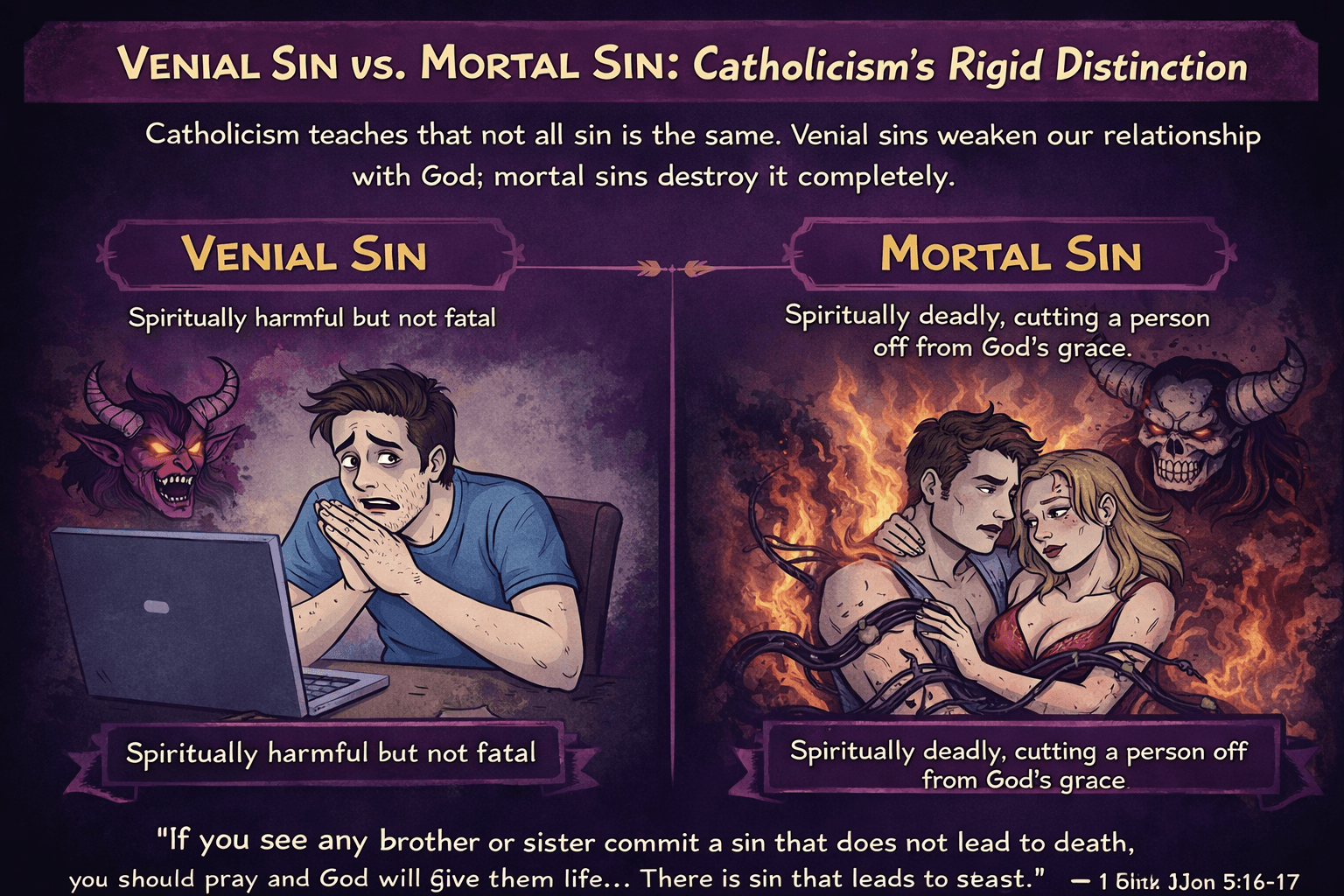
Venial sin. Spiritually harmful but not spiritually fatal
Mortal sin. Spiritually deadly, cutting a person off from God’s grace
Further reading: Will I Go To Hell For Masturbating? A Calm, Biblical Answer For Christians
Catholicism teaches that although every sin “misses the mark,” not every miss is the same. Some sins weaken a person’s relationship with God, while others destroy it entirely.
This approach flows from the Catholic reading of 1 John 5:16-17, where John explicitly distinguishes between “a sin that does not lead to death” and “a sin that leads to death.”
“If you see any brother or sister commit a sin that does not lead to death, you should pray and God will give them life. I refer to those whose sin does not lead to death. There is a sin that leads to death. I am not saying that you should pray about that. All wrongdoing is sin, and there is sin that does not lead to death.”
1 John 5:16-17
The Catechism of the Catholic Church states this clearly:
“Mortal sin destroys charity in the heart of man by a grave violation of God's law; it turns man away from God, who is his ultimate end and his beatitude, by preferring an inferior good to him. Venial sin allows charity to subsist, even though it offends and wounds it.” (CCC 1855)
The Catholic mindset is essentially, “All sin damages the relationship with God, but only mortal sin destroys it.”
Before we see how masturbation hits all three criteria for a mortal sin, we need to understand how the Scripture and the Church look at sexual sin.
What Scripture Says About Sexual Sin and the Body
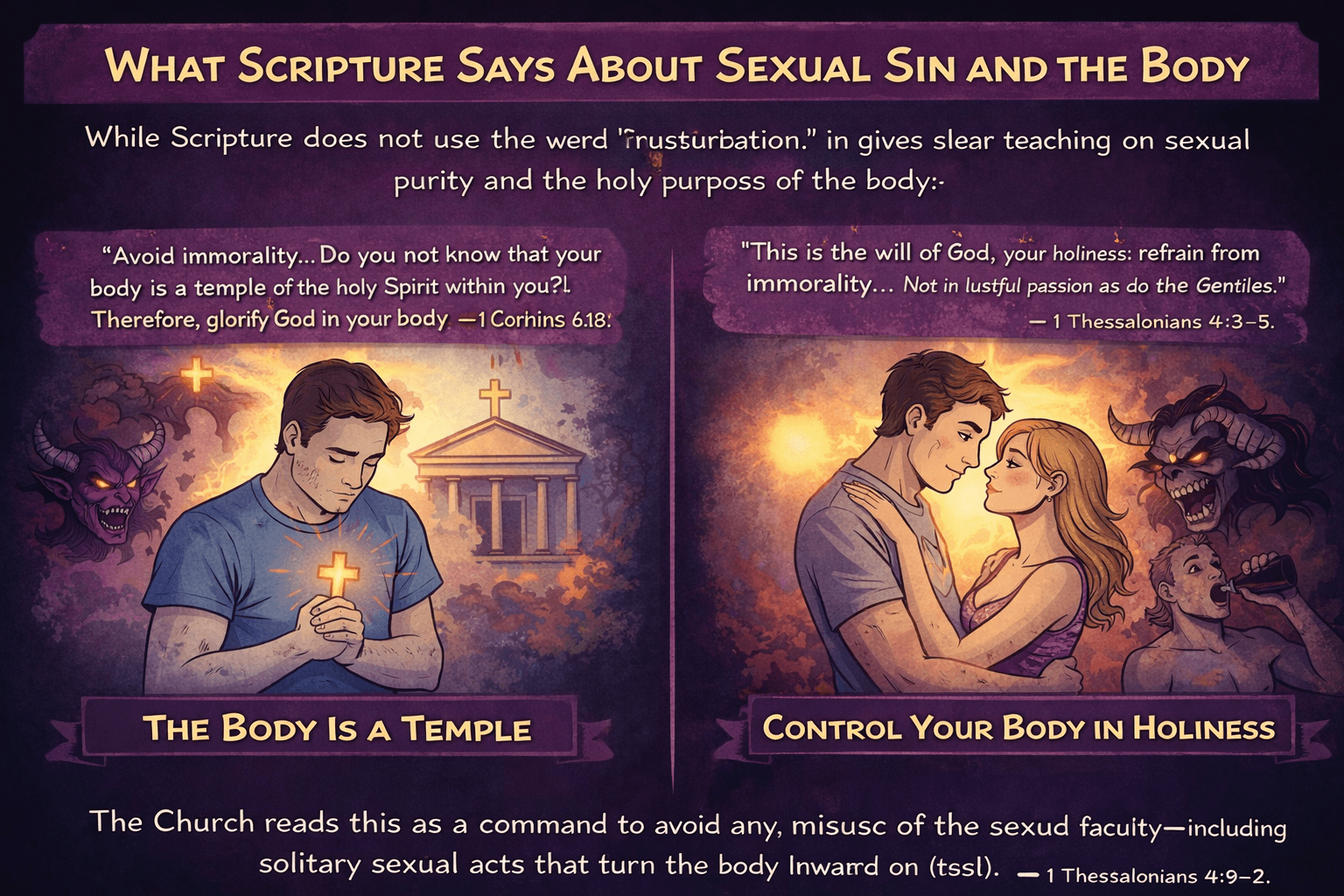
While Scripture does not use the word “masturbation,” it gives clear teaching on sexual purity and the holy purpose of the body:
The Body Is a Temple
“Avoid immorality. Every other sin a person commits is outside the body, but the immoral person sins against his own body. Do you not know that your body is a temple* of the holy Spirit within you,whom you have from God, and that you are not your own? For you have been purchased at a price. Therefore, glorify God in your body.”
1 Corinthians 6:18–20
The Church reads this as a command to avoid any misuse of the sexual faculty—including solitary sexual acts that turn the body inward on itself.
Control Your Body in Holiness
“This is the will of God, your holiness: that you refrain from immorality, that each of you know how to acquire a wife for himself in holiness and honor, not in lustful passion as do the Gentiles who do not know God;”
-1 Thessalonians 4:3–5
Masturbation is seen as a failure of this self-control and an act that stirs up desires outside God’s design.
The bible gives an even deeper breakdown about how it treats masturbation that's worth reading about.
Works of the Flesh
“Now the works of the flesh are obvious: immorality, impurity, licentiousness, idolatry, sorcery, hatreds, rivalry, jealousy, outbursts of fury, acts of selfishness, dissensions, factions,occasions of envy,* drinking bouts, orgies, and the like. I warn you, as I warned you before, that those who do such things will not inherit the kingdom of God.”
Galatians 5:19–21
Sexual immorality is listed among the sins that separate us from God.
These passages form the biblical foundation for the Church’s sexual ethic, which the Catechism then builds into its doctrine on mortal sin and masturbation.
Does masturbation fit all three criteria for a mortal sin?
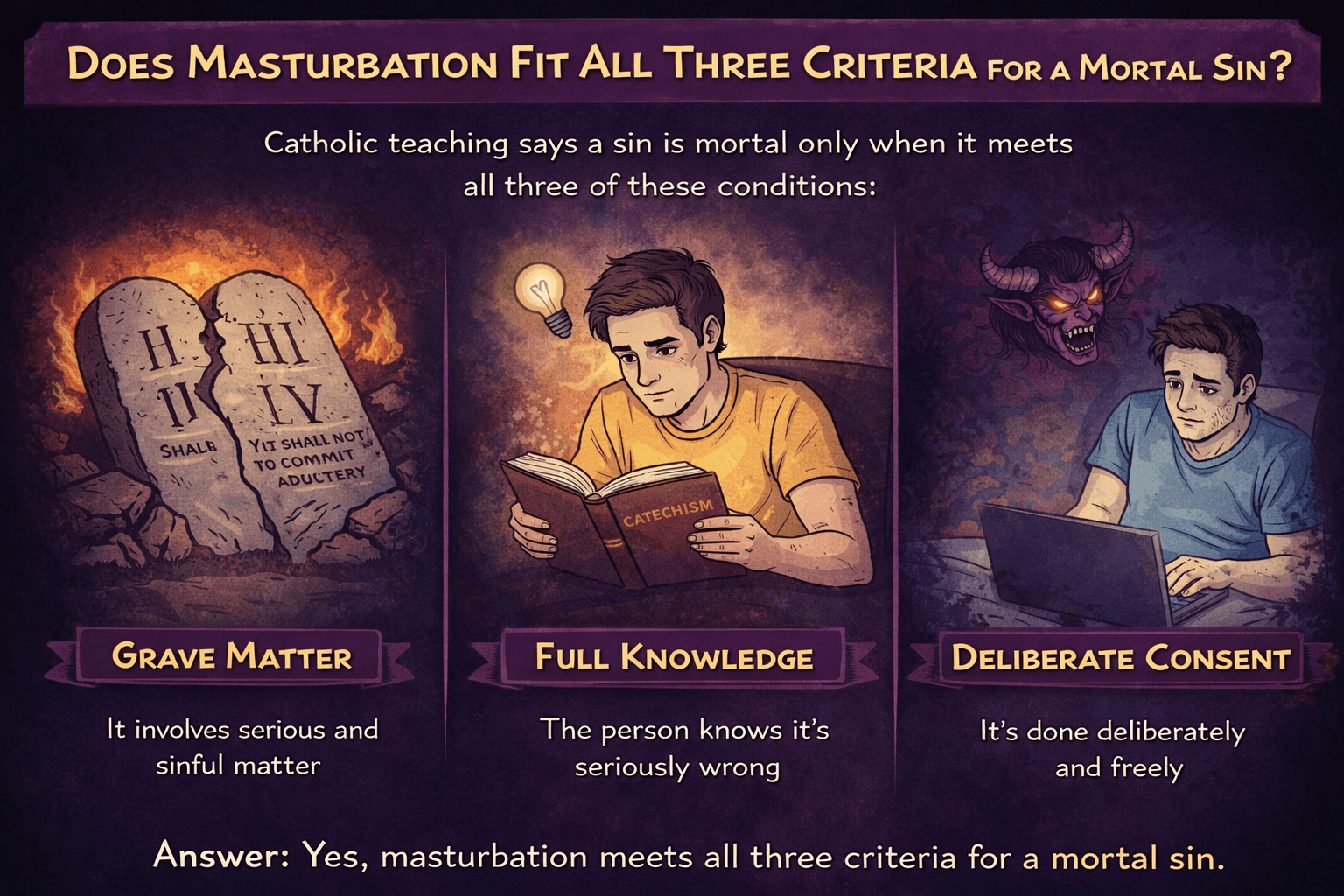
The Catholic Church teaches that a sin is mortal only when three conditions are present at the same time:
The act involves grave matter.
It is done with full knowledge that it’s seriously wrong.
It is carried out with deliberate consent. (CCC 1857)
Let’s take this one by one. For masturbation to be classified as a mortal sin, it has to meet all three of the following criteria.
1. Is masturbation a grave matter?
For all of its rigor, The Catechism of the Catholic Church doesn’t give a clean, direct definition of “grave matter.” Instead, it lets the Ten Commandments do the heavy lifting for defining “grave.”
“Grave matter is specified by the Ten Commandments, corresponding to the answer of Jesus to the rich young man: "Do not kill, Do not commit adultery, Do not steal, Do not bear false witness, Do not defraud, Honor your father and your mother."” (CCC 1858)
Now at first glance, the CCC does not seem to consider masturbation a mortal sin. But recall what Jesus says about lust.
Masturbation, Lust, and the Sixth & Ninth Commandments
Masturbation is not just a physical action. It almost always involves lust, which Jesus condemns explicitly:
“But I say to you, everyone who looks at a woman with lust has already committed adultery with her in his heart.”
-Matthew 5:28
Further reading: Is It A Sin To Look At A Woman? The Biblical Line Between Attraction and Lust
This ties masturbation to:
The Sixth Commandment: “You shall not commit adultery.”
The Ninth Commandment: “You shall not covet your neighbor’s wife.”
Even if no external act of adultery occurs, lustful intention violates the spirit of these commandments. This is why the Church views masturbation not merely as “private pleasure,” but as a distortion of the heart directed toward disordered desire.
Ok, it’s clear here that if you are married AND you masturbate WHILE thinking about another woman, you are committing a grave sin. But what if you’re single or you masturbate while only thinking about your spouse?
Catholicism seems to have that covered as well in the CCC.
“By masturbation is to be understood the deliberate stimulation of the genital organs in order to derive sexual pleasure. "Both the Magisterium of the Church, in the course of a constant tradition, and the moral sense of the faithful have been in no doubt and have firmly maintained that masturbation is an intrinsically and gravely disordered action." (CCC 2352)
Why the Church Says Masturbation Is “Intrinsically and Gravely Disordered”
To understand why the Church classifies masturbation as a grave matter, we have to look at the purpose God built into human sexuality.
Catholic moral theology teaches that every human faculty has a God-given purpose—or “end”—and using that faculty in a way that contradicts its purpose is called “intrinsic disorder.”
The Church teaches that sexual activity has two inseparable purposes:
Unitive. The complete gift of self between spouses
Procreative. Openness to the creation of life
Every sexual act must, at least in principle, be capable of expressing both.
Masturbation cannot satisfy either of these ends:
It is not unitive because it is not an act of self-gift
It is not procreative because it cannot create life.
Therefore, masturbation redirects the sexual faculty away from God’s design of self-giving love and toward isolated self-gratification. This is why the Church calls it “an intrinsically and gravely disordered action.”
This natural-law reasoning is the backbone of the Church’s stance.
Answer: Yes, no matter how you look at masturbation, the Church considers it a grave matter.
2. Is masturbation done with the full knowledge that it is against God’s wishes?
This is where the debate gets interesting.
In theory, every Christian should be well-versed in the Ten Commandments, and every Catholic should be well-versed in The Catechism of the Catholic Church.
The reality, according to a Pew Research on church attendance and religious activity within each religion:
30% of Christians seldom or never attend church
32% of Catholics seldom or never attend church
68% of Catholics seldom or never read Scripture
It’s important to note that these are not numbers for the general American population. These are people who self-identify as Christian or Catholic. It’s completely reasonable that many of them simply don’t know because they aren’t taking the religion seriously.
With that said, a favorite saying of mine is “Ignorance of the law does not protect you from the consequences of breaking it.” The stance has to be that you should know, even if you don’t know. Murder is still against the law, even if you didn’t know the law.
But murder isn’t masturbation. As Jules Winnfield says in Pulp Fiction, “It ain’t the same ballpark. It ain’t the same league. It ain’t even the same sport.”
I’m not saying that if you’re a Catholic and you know that masturbation is a grave matter, that you wouldn’t do it. I’m just saying that most Catholics don’t know that the CCC strictly deems masturbation intrinsically disordered.
This lack of knowledge is not a trivial matter either. Joe Heschmeyer explores this point in his article “How Hard Is It To Commit Mortal Sin.”
Ultimately, if you know you shouldn’t masturbate and you do anyway, you have met the second—and, most likely, the third—criteria for a mortal sin. If you didn’t know, and you’ve read this far, now you know.
Answer: It depends. If you don’t know (which you can no longer claim, if you’re reading this), then no, it isn’t. If you’re a Catholic and know the Church’s stance on masturbation, then it’s done with full knowledge—and that moves it into the territory of mortal sin. But as we’ll see in the next section, even this doesn’t make everything clear.
3. Is masturbation done deliberately (no one forces you to)?
Unless you are the victim of sex trafficking or sexual assault, masturbation—by its very nature—is done deliberately and with awareness of what you’re doing.
Answer: Assuming you aren’t a victim, you chose to masturbate and go through with it yourself, by the definition of “masturbate.”
What About Wet Dreams, Accidental Touching, and Involuntary Arousal?
The Church teaches that sin requires consent.
Therefore:
Nocturnal emissions (“wet dreams”) are not sinful
Half-awake touching without full awareness is not sinful
Biological arousal is morally neutral
Intrusive thoughts are not sinful unless deliberately entertained
Sin occurs only when someone consciously and deliberately chooses the act, with awareness of what they are doing.
This clarity is important because many Catholics—especially young ones—carry unnecessary shame over things that the Church does not consider sin at all.
Sometimes it’s not your fault—when a mortal sin is not a mortal sin
Now it looks like it’s pretty cut and dry that masturbation is a mortal sin.
But there are situations where, even though it may seem like all three conditions are met, your freedom is so weakened that it isn’t truly mortal.
Let’s start this section with a talk about our laws on murder. This may not seem relevant, but this will help you understand.
With the exception of justifiable self-defense, it’s against the law to take someone’s life. However, the manner and motivation of the homicide determine its classification and the penalty you receive. Generally (though not universally), it looks something like this:
Plan for it meticulously, and you get life in prison without parole. (1st degree murder)
Do it while committing another felony, like robbing a bank, and you’re looking at at least 25 years. (2nd degree murder)
Take someone out when you only meant to harm them but not kill them, and you’re looking at 10-20 years. (Voluntary manslaughter)
End someone’s life while being reckless, and you’re looking at 6-12. (Involuntary manslaughter)
The idea is that taking someone’s life is a big deal. Some would argue, the biggest deal. So, unless you were defending yourself from them trying to take yours, the circumstances mitigate the punishment.
The Catechism of the Catholic Church has a similar idea when it comes to mortal sin.
“Freedom makes man responsible for his acts to the extent that they are voluntary. Progress in virtue, knowledge of the good, and ascesis enhance the mastery of the will over its acts.” (CCC 1734)
Followed up by…
“Imputability and responsibility for an action can be diminished or even nullified by ignorance, inadvertence, duress, fear, habit, inordinate attachments, and other psychological or social factors.” (CCC 1735)
Further reading: Is Watching Porn A Sin? Understanding The Question Christians Are Really Asking
The Church acknowledges that while freedom of choice makes you responsible for your actions—like committing a mortal sin—there are conditions that diminish or even nullify the blame you take. All of this is the Church’s way of acknowledging that freedom isn’t binary.
The condition most relevant to masturbation and sin is inordinate attachments. These are addictions, compulsions, and emotional dependencies that distort your priorities and weaken your ability to choose the good.
I group those in with the “broader psychological factors” because that covers everything: trauma (a well-researched and understood driver of addiction), anxiety, depression, and even cultural norms.
Why Addiction Reduces Culpability (But Not the Gravity of the Act)
All of this contributes to the main driver of masturbation—pornography addiction.
So even if you know it’s wrong, the addictive nature of internet pornography may seriously weaken your freedom.
That doesn’t make the act good, but it does mean God and the Church take your struggle, not just your failures, into account.
Shame vs Guilt: What the Church Actually Wants You to Feel
Catholic teaching draws a sharp distinction between guilt and shame:
Guilt. “I did something wrong.” → This can lead to repentance and healing.
Shame. “I am something wrong.” → This isolates people from God’s mercy.
The Church does not want you drowning in shame.
Further reading: Does God Forgive Lust? Yes—Even When You've Failed Repeatedly
Even mortal sin is not meant to crush you—it calls you back to the Father who runs to meet the prodigal son.
God’s mercy always outweighs your weakness.
So the next question is “What are you going to do about it?”
How Can I Stop Touching Myself?
Many others have tried to quit with no success because of the addiction, even though they desperately want to stop. These individuals know that pornography is destroying their relationships, self-worth, and life, but it’s a powerful beast, and you may need help.
If you or someone you love has been struggling with porn addiction or masturbation, consider joining Relay! Relay is a community-focused recovery program where Christians can heal side by side from negative sexual habits like masturbation or pornography addiction.
But no app or program will matter if you don’t want to stop. And you’re reading this because you do. Along with the Relay, there’s one more thing you have to do.
Beyond the spiritual alignment, there are a lot of great benefits to not masturbating as well.
Repent From Touching Yourself
Understanding the gravity of touching yourself, the Church emphasizes the necessity of repentance and seeking God's forgiveness. Psalm 51:10 provides a prayerful plea for transformation, saying, "Create in me a clean heart, O God, and put a new and steadfast spirit within me."
Through sincere repentance, we acknowledge our sins, seek sacramental confession, and receive God's merciful forgiveness. The sacrament of confession provides us with the opportunity to reconcile with God, regain sanctifying grace, and receive guidance and strength to overcome temptation.
In addition to, or as a part of, confession, God and His servants ask us to do more than reciting our sins - we are to take action to resolve them. This can include such steps as fasting and prayer, attending support groups or Christian therapy, and even finding apps or programs like Relay that will help to overcome your habit of touching yourself.
Repentance requires a firm resolve to amend one's life and actively strive for holiness. This transformative journey is supported by the intercession of Our Lady, who embodies purity and serves as a role model for all believers. By placing our trust in Our Lord and seeking the intercession of Our Lady, individuals can find solace, forgiveness, and the grace necessary to lead lives of virtue and purity.
Further reading: Will God Forgive Me For Watching Bad Things? Yes—Even After Repeated Failure
Final take on masturbation and mortal sin
Touching yourself in a sexual manner is always a grave matter in Catholic teaching. When it’s done with full knowledge and full consent, it’s a mortal sin. It is a serious matter that goes against the sanctity of our bodies, involves intention and consent, defiles the sanctity of marriage, and can lead to habits that are hard to break.
With that said, the Church recognizes that sometimes, there are circumstances that make it hard for you to overcome bad habits and tendencies. You can’t do it alone.
No matter how often you’ve fallen, the path back is always the same: turn to God, confess honestly, and cooperate with His grace.
May we all strive to live in accordance with God's plan, cultivating purity, and seeking to glorify Him in all that we do.
If you want help with living in accordance to God's plan, try Relay for free for 7 days. Relay offers a faith-based porn recovery option, paired with sound psychological guidance, licensed counselors, and peer recovery specialists who know what it's like.
References
Catechism of the Catholic Church (CCC)
Promulgated by Pope John Paul II, 1992.
© Libreria Editrice Vaticana.